Why Abhimanyu Really Died in the Chakravyuh
rudrametaverse
October 16, 2025
Abhimanyu didn’t fall only because he didn’t know the exit. He was pushed into a high-risk formation, left without support when the lines resealed, fought to deep exhaustion, and was finally killed in a way that broke the rules of war encircled and struck even after he was unarmed.
The legend we remember and the truth we overlook
We often repeat the headline: Abhimanyu knew how to enter the Chakravyuh but not how to exit it. True. But that single fact blurs a harder reality. His last stand was shaped by strategy, isolation, fatigue, and a final breach of dharma. When you line up the events in order, his death looks less like a simple mistake and more like a tragic inevitability.
A deliberate, high-stakes entry
Abhimanyu was asked to break the Chakravyuh even though it was known he didn’t know the way out. Once he pierced the first ring, the formation closed behind him and tightened. This wasn’t casual bravado; it was a calculated move in a brutal chess match where sacrifices shift momentum.
Short sequence of what unfolded
- Order to breach the formation despite the known knowledge gap.
- Entry achieved; the front line reconfigured immediately.
- The “door” shut; Abhimanyu was now inside without a mapped exit.
Core idea: A strategy can be necessary and still be costly.
The support never arrived
The expectation was simple: Abhimanyu would breach; senior warriors would follow. But the front rank resealed stronger than before. Even powerful allies Bhima, Satyaki, Nakula, Sahadeva couldn’t get in. Abhimanyu kept moving toward the center alone.
Reality check
- The plan relied on perfect timing.
- The formation adapted faster than the support could respond.
- The lead fighter became isolated in enemy geometry.
Exhaustion at the heart of the formation
Layer after layer, Abhimanyu fought while those positioned inside waited fresh. He still landed decisive blows most notably the killing of Lakshmana, Duryodhana’s son but sustained intensity drains judgment and speed. Fatigue doesn’t announce itself; it trims reaction time by fractions, and that’s enough to tilt a battle.
A quick analogy: It’s like sprinting repeated laps while your opponent steps in only for the final one.
A death that broke the code
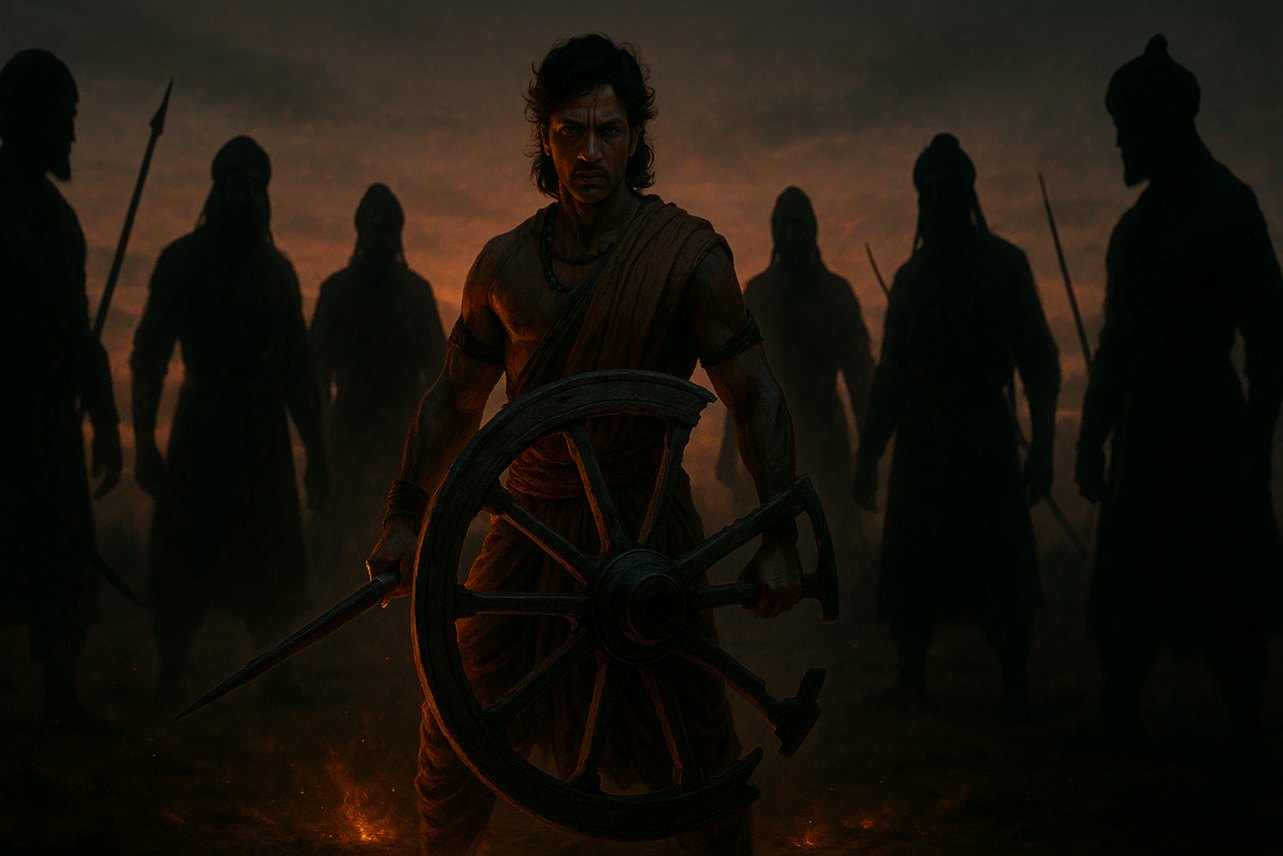
At the seventh and final stage, Abhimanyu was surrounded by seven warriors, including Jayadratha and Duryodhana. His horses were killed, his bow destroyed, his chariot shattered. He lifted a broken wheel as a shield and kept fighting with a sword until that too broke. By the rules of war, an unarmed warrior should not be struck. Yet blows came from multiple sides. That is how a sixteen-year-old fell.
Essential takeaway: The manner of Abhimanyu’s killing violated the very ethics meant to protect every combatant.
Why This Matters Now
Abhimanyu’s story isn’t just a relic from an epic. It’s a mirror held up to modern life:
- Strategy vs. safeguarding people:A brilliant plan still fails if it strands the person executing it.
- Team design in high pressure:If support can’t follow, the breach becomes a trap.
- Human limits are real:Sustained effort without relief turns skill into risk.
- Ethics under stress:Rules matter most when they’re most inconvenient.
To honor Abhimanyu is to praise his courage and to learn from the design flaws and ethical breaks that ended his life. May our strategies protect the brave, keep the team together, and hold the line when it’s hardest to do so.