
The Statue That Came Alive: A Vrindavan Story of Faith and Seeing
rudrametaverse
November 9, 2025
vrindavan-statue-that-came-alive
When devotion looks at a stone and sees a living presence, the world tilts truth reveals itself in ways logic cannot predict.
The tale
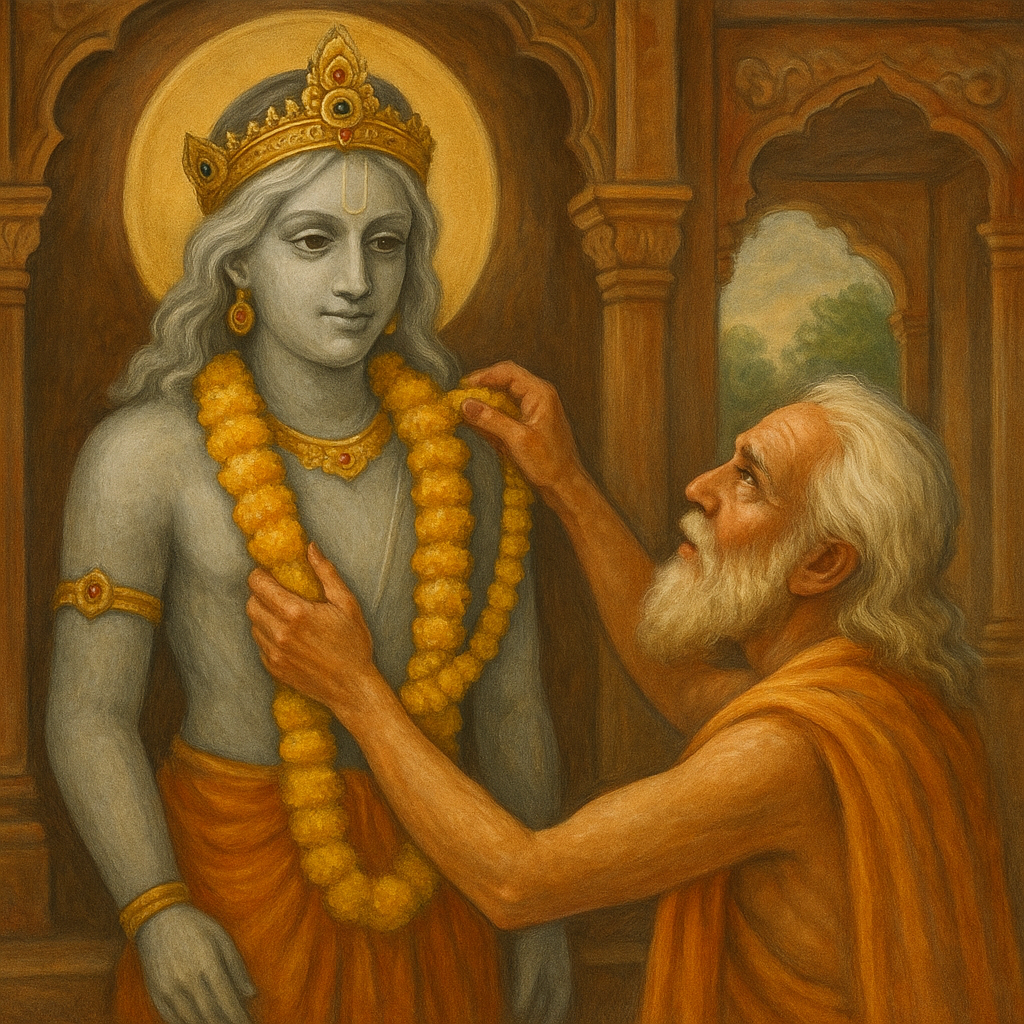
In Vrindavan, a king built a temple for Lord Krishna and appointed a priest to serve there. The priest served with a lifetime of devotion. Each day the king sent a garland through a servant; the priest would place it on the deity, then remove it and put it around the king’s neck when the monarch visited. One day the king could not come and ordered his servant to deliver the garland and say he would not visit. The priest, thinking he would never again be fortunate enough to wear the garland placed it on himself. Terrified when he learned the king was arriving after all, the priest stealthily returned the garland to the deity before the king’s visit.
The king noticed a white hair in the garland and, believing the priest had stolen it, threatened to execute him unless the deity’s hair matched the claim. The next morning the king opened the deity’s crown and found all the hair white and bleeding when plucked. The deity spoke: the priest sees me as living; the king only as a statue. To protect the priest’s faith, the divine assumed this form and bled to make the king understand. The king fell at the deity’s feet, repentant.
What this story is really about
At first glance this is a miracle tale. At a deeper level it is a parable about perception about how devotion transforms matter into presence. The priest’s heartfelt service made the stone a living other. The king’s transactional relationship reduced the divine to ornament. The story asks: what shapes the reality we inhabit our outer actions, or the inner posture we bring to them?
Three lessons for everyday life
1) Faith enlivens the ordinary
Objects and rituals themselves are inert. They become meaningful when held by heartfelt attention. The same garland that is mere jewelry for the king becomes a sacrament for the priest because of the inner regard given to it.
2) Seeing is not neutral attention creates reality
The priest’s continuous service tuned him to presence. The king, who treated worship as formality, only learned to see after a shock to his senses. Our attention how we attend to people, work, or moments shifts what they become for us.
3) Compassion is awakened by being shown the other’s inner world
The king’s repentance is the story’s hinge. When someone’s inner life is revealed, justice and punishment no longer feel right. The impulse is to make amends, not to punish. True understanding softens the heart.
Modern relevance: a contemporary parable
Replace the temple with a workplace, a relationship, or a community project. When we treat colleagues as functions and metrics instead of people, we miss the living presence in front of us. When we cultivate respect and attentive service small acts repeated people and places change. The story is a reminder that dignity often comes from being truly seen, and that rituals whether a morning check-in, a ritual email, or a handwritten note gain power when rooted in presence, not optics.
Practice to carry home
- Before you act, ask: Am I doing this out of habit or from care?
- Offer one small, consistent act of service no fanfare, no expectation of return for thirty days. Notice how your perception of that person or task changes.
- If you meet resistance or judgement, assume a patient stance: people often need an experience, not an argument, to shift their seeing.
A final image
The priest did not plan the miracle. He only cultivated a life of service so steady that the boundary between stone and spirit dissolved. That slow, ordinary tending is the temple-making work each of us can do.
FAQ
Q: Is the story saying statues are literally alive?
No its power lies in metaphor. The tale shows how devotion makes presence palpable. Whether or not one accepts a literal miracle, the psychological truth remains: wholehearted attention can radically transform how we experience people and things.
Q: How do I practice this kind of devotion in a secular life?
Make presence the criterion, not performance. Treat one daily obligation an email, a call, a household chore as sacred: do it with full attention, devoid of multitasking. Over time, the quality of engagement will shift.
Q: What if others mock my sincerity?
The priest was almost punished; sincerity does not always win immediate approval. Yet the story shows that genuine care ultimately alters outcomes and softens hearts. Keep tending your practice quietly.